

Managing Family Finances While You Work Abroad

20 Aug 2026

You Work Overseas to Build a Better Life. Is Your Family’s Money Working Toward the Same Goal?
An overseas salary often carries more responsibility than personal expenses. It may help pay for a child’s education in Indonesia, support parents back home, cover household bills, repay debts, or contribute to a family’s dream of owning a home.
But there is a challenge that many workers discover only after spending years abroad:
Earning more money does not automatically mean becoming financially secure.
You can work overseas for years, send money home every month, and still return to Indonesia without enough savings for your own future.
This is why managing family finances is just as important as earning an overseas salary.
The issue is significant enough that financial literacy for Indonesian migrant workers and their families has become an active focus of the Indonesian government. In November 2025, OJK, Bank Indonesia, and the Ministry of Migrant Worker Protection launched a dedicated Financial Literacy Guide for Indonesian Migrant Workers and Their Families, specifically to help PMI manage money safely and sustainably.
In June 2026, KP2MI also worked with IOM and other partners on a smart budgeting programme for PMI and their families, highlighting the continuing importance of financial planning rather than simply earning and sending money.
So, how can an Indonesian worker abroad make sure today’s salary helps create a stronger family tomorrow?
1. Start With One Number: How Much Can You Actually Afford to Send Home?
One of the biggest mistakes is deciding the remittance amount first and working out the budget afterward.
Reverse the process.
Start with your actual monthly income and expenses.
For example:
| Monthly financial priority | Example |
|---|---|
| Living expenses abroad | Rp5 million |
| Family remittance | Rp4 million |
| Personal savings | Rp2 million |
| Emergency savings | Rp1 million |
| Other obligations | Rp3 million |
The numbers above are only an illustration. Every PMI has different income, country, accommodation arrangements, family responsibilities, and debts.
The important lesson is:
Your family support amount should be sustainable.
Sending a large amount one month and struggling to pay your own essential expenses the next month is not a good long-term strategy.
2. Separate “Family Needs” From “Extra Requests”
When you are far away from home, it can be difficult to judge whether a financial request is truly urgent.
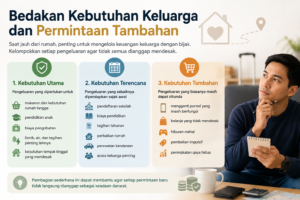
Try dividing family spending into three groups.
Essential
Money needed for:
- food and household necessities
- children’s education
- medical expenses
- electricity, water and other essential bills
- urgent housing needs
Planned
Expenses that should be anticipated:
- school registration
- tuition payments
- annual fees
- home repairs
- vehicle maintenance
- important family events
Optional
Expenses that can usually wait:
- upgrading a phone that still works
- unnecessary shopping
- expensive entertainment
- impulse purchases
- lifestyle upgrades
This simple classification can prevent every new request from becoming an “emergency.”
3. Set a Regular Remittance Schedule
Instead of sending money every time someone asks, establish a predictable schedule.
For example:
Every 5th of the month → household support
Every 15th → education savings
End of month → emergency or personal savings
The schedule will depend on when you receive your salary and your family’s needs.
The benefit is simple: everyone knows what to expect.
Your family can plan their expenses around the expected remittance, while you can protect money for your own savings and obligations.
This also makes it easier to track how much you are actually sending home each year.
4. Don’t Let Remittance Become the Family’s Only Source of Income
This is especially important for PMI who have been working abroad for several years.
A healthy family financial plan should gradually move from:
“The worker sends money → family spends it.”
toward:
“The worker sends money → family saves and uses part of it to build future income.”
For example, part of the remittance could eventually support:
- a small food business
- agricultural activities
- a shop or online business
- vocational training
- productive equipment
- education that improves future earning potential
The objective is not to stop supporting your family.
The objective is to help your family become more financially resilient.
KP2MI has specifically encouraged PMI families to use remittances productively rather than allowing overseas earnings to disappear entirely into consumption.
5. Build an Emergency Fund in Indonesia
A family emergency fund can prevent a worker from having to send unexpected money every time something goes wrong.
It can be used for genuine emergencies such as:
- sudden medical treatment
- urgent repairs
- unexpected travel
- temporary loss of household income
- other essential expenses
Keep this money separate from regular household spending.
A useful rule is:
Monthly remittance pays for the month. Emergency savings pays for the unexpected.
Even a small amount saved consistently can make the family less dependent on last-minute transfers.
6. Don’t Forget Your Own Savings
This is one of the most important lessons for overseas workers.
Your family’s future depends partly on your financial future.
If you send almost everything home every month but have no personal savings, what happens when:
- your overseas contract ends?
- your employer changes?
- you become unable to work temporarily?
- you decide to return to Indonesia?
- you need capital to start a business?
Your overseas income is an opportunity — but it will not necessarily last forever.
That is why your personal savings should be treated as a priority, not whatever money happens to be left at the end of the month.

7. Have a Money Conversation With Your Family
You do not need to become your family’s accountant.
But everyone should understand the basic financial plan.
Once a month, discuss:
How much money is coming in?
What are the important expenses next month?
Are there any large expenses coming soon?
How much has been saved?
Are we still on track toward our main goal?
This is particularly important when the worker is supporting several family members.
For example, a worker may think the monthly remittance is being used mainly for household expenses, while family members are using part of it for other purposes.
A short monthly conversation can prevent months of misunderstanding.
8. What Should You Do When Your Family Asks for More?
Imagine you normally send Rp5 million every month.
Then you receive a message:
“We need another Rp3 million this month.”
Before immediately sending it, ask:
Is it genuinely urgent?
Can the expense wait?
Is there already savings available in Indonesia?
Can the expense be reduced or split into several payments?
Will sending the extra money affect my own essential expenses?
For a genuine medical emergency, the answer may obviously be different.
But if additional requests happen repeatedly, it may be a sign that the family’s monthly budget needs to be reviewed.
Saying “I cannot send more this month” does not mean you do not care.
Sometimes, setting a financial boundary is part of taking care of your family.
9. Be Careful With Borrowing to Cover Family Expenses
There can be situations where additional financing is genuinely necessary.
But borrowing should not become the default solution every time the family goes over budget.
Before taking a loan, ask:
- How much do I actually need?
- What will the money be used for?
- How much will I repay in total?
- Can I afford the repayment schedule?
- Are the fees and terms clearly explained?
- Is the provider legitimate?
Indonesian authorities have continued to emphasize safe use of financial services and protection from illegal financial activities as part of PMI financial literacy efforts.
For workers who genuinely need financing, you can learn more about EzyCash’s lending services and review the applicable terms before deciding.
The goal should be to solve a genuine financial need — not create a new long-term burden.
10. Give Your Family’s Money a Bigger Purpose
A remittance should not only answer:
“What does my family need this month?”
It can also answer:
“What can this money help my family achieve next year?”
For example:
Short-term goal
Cover household expenses consistently.
Medium-term goal
Build an emergency fund or pay education costs.
Long-term goal
Build a house, start a business, develop skills, or prepare for your return to Indonesia.
This shift in thinking can make a huge difference.
Instead of simply sending money, you are building a financial plan together with your family.

Work Abroad for a Better Future, Not Just a Bigger Paycheck
For an Indonesian migrant worker, every month overseas represents time spent away from home.
That sacrifice deserves a financial plan.
Create a realistic remittance amount. Separate needs from wants. Build an emergency fund. Save for yourself. Talk openly with your family. And whenever possible, use part of your overseas income to create future sources of financial security.
The goal is not to send the most money possible.
The goal is to make the money you work so hard to earn create the greatest possible benefit for your family — today and in the future.
Your overseas job may last a few years.
The financial decisions you make during those years can affect your family for decades.